

PCB Fab Dust Capture: Compliance-First Vacuum Systems

In PCB fabrication, the difference between a clean board and a board carrying foreign debris often comes down to one number: 50 to 70 inches of water, inWG, at each machine head. That is the target range TVD looks for on drilling, routing, and lasering lines. The common industry condition is closer to 30 inWG, especially on older central systems with neglected tubing and filters.
That gap is not academic. Excellon, Schmoll, and Hitachi drill, route, and laser equipment can run multiple heads per machine, typically five to six. If each head is under-pulled, copper and fiberglass fines remain on the panel, in the holes, or around the work area. Reject rates creep up, operators start chasing symptoms, and the vacuum system becomes a production risk instead of a controlled utility.
The practical benchmark: TVD targets 50 to 70 inWG per machine head for clean PCB drilling, routing, and lasering. If your system is delivering around 30 inWG, the issue is often not the pump. In many PCB shops, the root cause is leaking, undersized, abandoned, or poorly filtered vacuum tubing.
Why PCB Dust Is a Different Challenge
PCB dust is primarily copper and fiberglass from FR-4 laminate. It is fine particulate, abrasive, and persistent. It is not combustible in the classic explosive sense that drives many combustible dust discussions in other industries, but it still requires disciplined capture, filtration, and housekeeping. The concern is contamination control, worker exposure, equipment reliability, and keeping debris out of holes, slots, channels, and finished surfaces.
Multi-head machines make the problem more demanding. A five-head or six-head drill line is not one pickup point. Each head needs sufficient vacuum, and the duct design must account for total CFM, distance from the collector, branch losses, and the way operators actually run the line. If one abandoned open line is bleeding vacuum, the entire connected group can suffer. TVD regularly finds open drops, improvised hose connections, crushed tubing, overloaded filters, and undersized branches that pull performance below the clean-production range.
Spencer Turbine systems are the incumbent in a large majority of existing PCB installs. In TVD’s field experience, roughly 90 percent of legacy PCB central vacuum rooms involve Spencer equipment. The pump is often not the failure point. The larger problem is what happens downstream and upstream: tubing condition, filtration, bag loading, leaks, and maintenance practices. TVD services Spencer systems, supplies filters, bags, and replacement parts, performs tubing inspections, and commissions used units purchased through industrial auction channels such as GoIndustry, HGP, Heritage Global, and Rabin. Some used units are 15 or more years old and can still be put to work when the installation is engineered correctly.

Compliance Context for PCB Fabrication
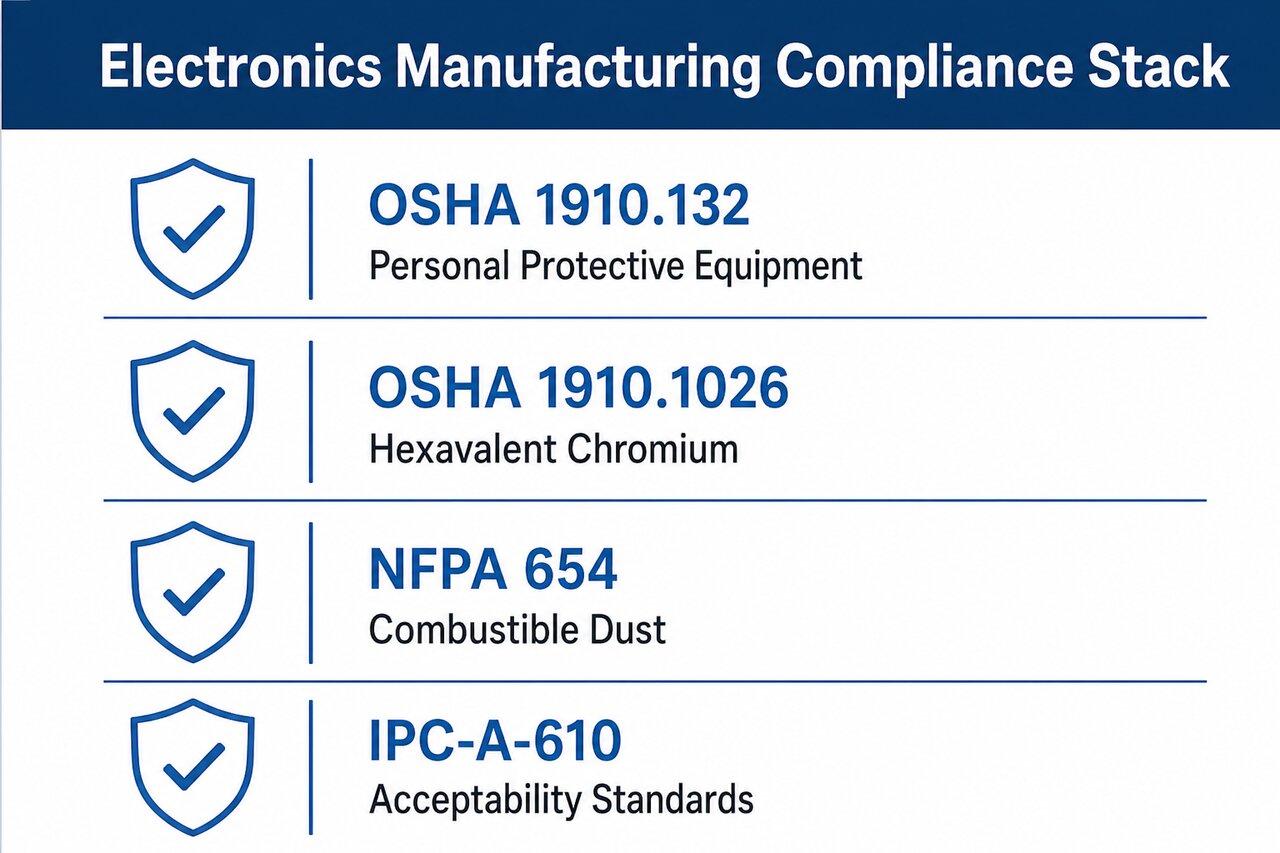
For PCB shops, the compliance-first discussion starts with housekeeping, exposure control, and documented maintenance. OSHA 29 CFR 1910.22 requires work areas to be kept clean, orderly, and sanitary. Fine copper and FR-4 dust around machines, on floors, and in production aisles is a housekeeping and operational control issue, especially in plants running two or three shifts with little scheduled vacuum maintenance.
OSHA 29 CFR 1910.1053 may also be relevant if process data, material information, or sampling indicates respirable crystalline silica exposure. PCB materials vary, and the correct path is to evaluate the dust stream and applicable exposure limits instead of assuming one generic rule covers every line. A properly designed industrial vacuum system supports compliance by capturing dust at the source, reducing fugitive particulate, and making filter service a planned task instead of an emergency response.
Common crisis call: “Vacuum is down, and we are running shop-vacs on the machines.” TVD gets these calls from PCB plants that have been operating for years with no scheduled vacuum maintenance. The goal is to move the facility from crisis-driven cleanup to measured, repeatable dust capture.
System Selection: Matching the Solution to the Facility
For a permanent PCB facility-wide solution, TVD commonly specifies the DuroVac CORE CENTRAL as its competitive alternative to legacy Spencer Turbine systems, typically in the 10 to 25 HP range depending on machine count, head count, distance, and calculated airflow. The system is selected around the production requirement, not just the nameplate horsepower. The target remains measurable vacuum at the machine heads, with the system operating in the 50 to 70 inWG range where clean drilling, routing, and lasering are more achievable.
For plant managers who want proof before committing capital, TVD offers a rental demo option. A 10 HP portable DuroVac unit can deliver 60 to 70 inWG and typically connects to one or two machines. The rental is priced at $1,500 per week or $3,000 per month. It requires only 480V 3-phase power, which PCB plants already have because Excellon, Schmoll, and Hitachi production machines run on 480V.
This is often the lowest-risk ROI step. If the demo raises vacuum from the common 30 inWG range into the 50 to 70 inWG target, the team can evaluate board cleanliness, debris reduction, operator feedback, and reject trends before approving a permanent CORE CENTRAL installation. The return is not theoretical equipment savings. In PCB fabrication, the return comes from fewer rejects, fewer filter scrambles, less unplanned downtime, and a system that can run two or three shifts with scheduled service instead of emergency shutdowns.
Installation Details That Matter
The installation signature for PCB vacuum is proper industrial ducting. TVD uses carbon steel or schedule 40 galvanized ducting. Not PVC. Not AC duct. Not ABS. Typical layouts use 4-inch mains, 3-inch branches, and 2-inch drops per machine, with final sizing based on distance, head count, and CFM calculation. The tubing design is where many systems either succeed or fail.
A typical installation includes three to five days of piping while the plant continues operating, followed by a three to four hour final hookup during a scheduled maintenance window. TVD handles engineering, tubing design, installation, commissioning, and verification. Before and after startup, TVD measures vacuum at every machine head so the plant knows what changed and where performance stands.
That turnkey engineering model is the difference. Many providers can sell equipment. TVD is an Orange County industrial vacuum engineering firm that designs the system around the machines, the duct path, the filters, and the production target. Whether the plant is servicing an existing Spencer system, exploring central vacuum system design,, installing a used auction unit, testing a rental demo, or moving to a DuroVac CORE CENTRAL, the objective is the same: verified vacuum at the heads and controlled dust capture at the source.
The practical benchmark: 50 to 70 inWG per machine head. Most legacy central systems deliver closer to 30 inWG – enough gap for copper and FR-4 debris to stay on the board.TVD Field Standard
Frequently Asked Questions
What vacuum level should a PCB drill or router head have?
Do we need to replace our Spencer system?
Can we test the improvement before buying a permanent system?
How long does a permanent installation take?
Bring Your PCB Vacuum System to Measured Performance
If your drill, route, or laser line is running below the 50 to 70 inWG target, TVD can inspect the existing system, measure vacuum at each head, identify duct and filter losses, and specify the right correction.
Schedule Your Intro Call